




Daisuke Inoue, Koichiro Miike, Shunsuke Tanigawa, Kei-ichiro Yasunaga, Rae Maeda, Tomoko Ohmori, Sayoko Fujimura, Masashi Mukoyama, Tomomi Kamba, Jose Aramburu, Cristina Lopez-Rodriguez, Yuki Sugiura, Yuichiro Izumi, Ryuichi Nishinakamura. Tonicity drives collecting duct maturation in the mammalian kidney. Nature Communications, on line, 2026.
We have found that salt — the sodium chloride that accumulates in the inner part of the kidney as the organ matures — acts as a signal that drives the collecting duct to mature, and have turned that finding into a new method for maturing kidney organoids. The resulting human collecting duct organoids reach a maturity comparable to the newborn or even the adult kidney, and reproduce the pathology of nephrogenic diabetes insipidus. This work converts a basic feature of kidney physiology into a practical tool, and marks an important step toward next-generation kidney organoids for disease modelling, drug discovery and transplantation.
The kidney is a vital organ that maintains the body’s homeostasis including water homeostasis. In particular, the central region called the medulla has high salt and urea for water reabsorption in the collecting ducts. What these molecules do during kidney development, however, has remained unknown.
Our team, led by Prof. Ryuichi Nishinakamura (Department of Kidney Development, Institute of Molecular Embryology and Genetics (IMEG), Kumamoto University), has pioneered methods for inducing kidney organoids (mini-kidneys) from pluripotent stem cells. These methods have been used successfully to generate kidney tissue with complex three-dimensional structure (Cell Stem Cell 2013 & 2017, Nat Commun 2022 & 2025). The maturity of these organoids, however, has remained at a fetal level, and this immaturity has been a major obstacle to disease modelling, drug development and, ultimately, transplantation therapy.
In this study, Daisuke Inoue, a PhD student in Prof. Nishinakamura’s group, discovered that salt matures the kidney collecting ducts, and developed a new method for maturing mouse and human kidney organoids. Single-cell RNA sequencing showed that the matured collecting duct organoids were far more mature than previous organoids, reaching newborn or even adult levels. Using these mature organoids, he reproduced the functional features of both congenital and acquired (drug-induced) nephrogenic diabetes insipidus.
This work presents a new concept: salt matures the kidney. The maturation method can also be applied to modeling other collecting duct diseases, such as autosomal dominant polycystic kidney disease. Moreover, kidney organoids which autonomously accumulate salt inside will represent an important step towards next-generation, transplantable kidney organoids.
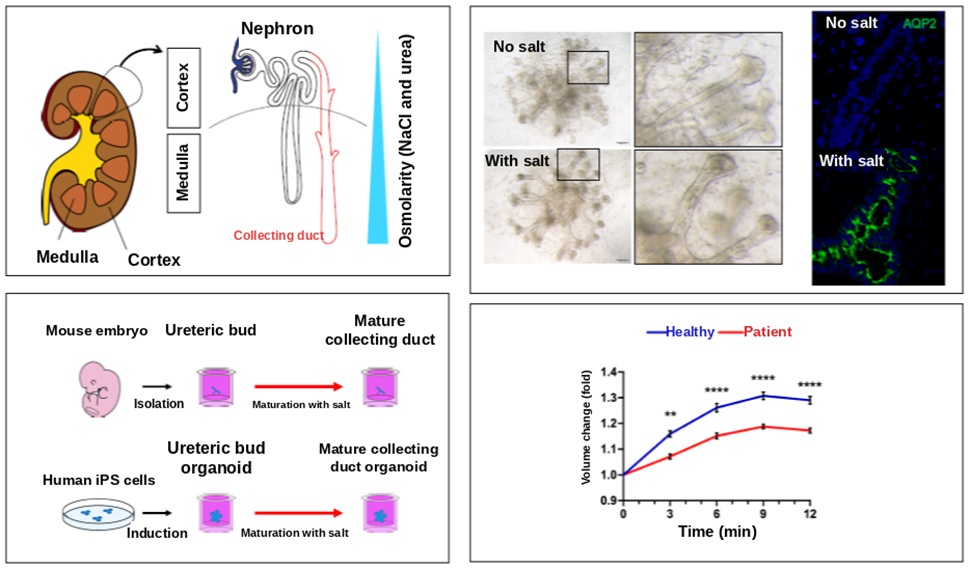
Figure legend
In the medulla at the center of the kidney, salt and urea accumulate and a high-osmolarity environment is maintained (upper left). In this study, ureteric buds isolated from mouse embryos, and ureteric bud organoids induced from human induced pluripotent stem cells, were cultured with added salt to generate mature collecting ducts (lower left). The human collecting duct organoids matured morphologically, and the amount of the key water channel, aquaporin-2 (AQP2) (protein expression) increased (upper right). A gene mutation reported in patients with congenital nephrogenic diabetes insipidus was introduced into iPS cells, mature collecting duct organoids were induced, and their water permeability was assessed. Permeability was reduced in the patient-mutant organoids, consistent with the impaired urine-concentrating ability seen in patients with nephrogenic diabetes insipidus (lower right).


